
1906 Indian Head Penny: What Makes a Coin Worth Five-Figure Amount?
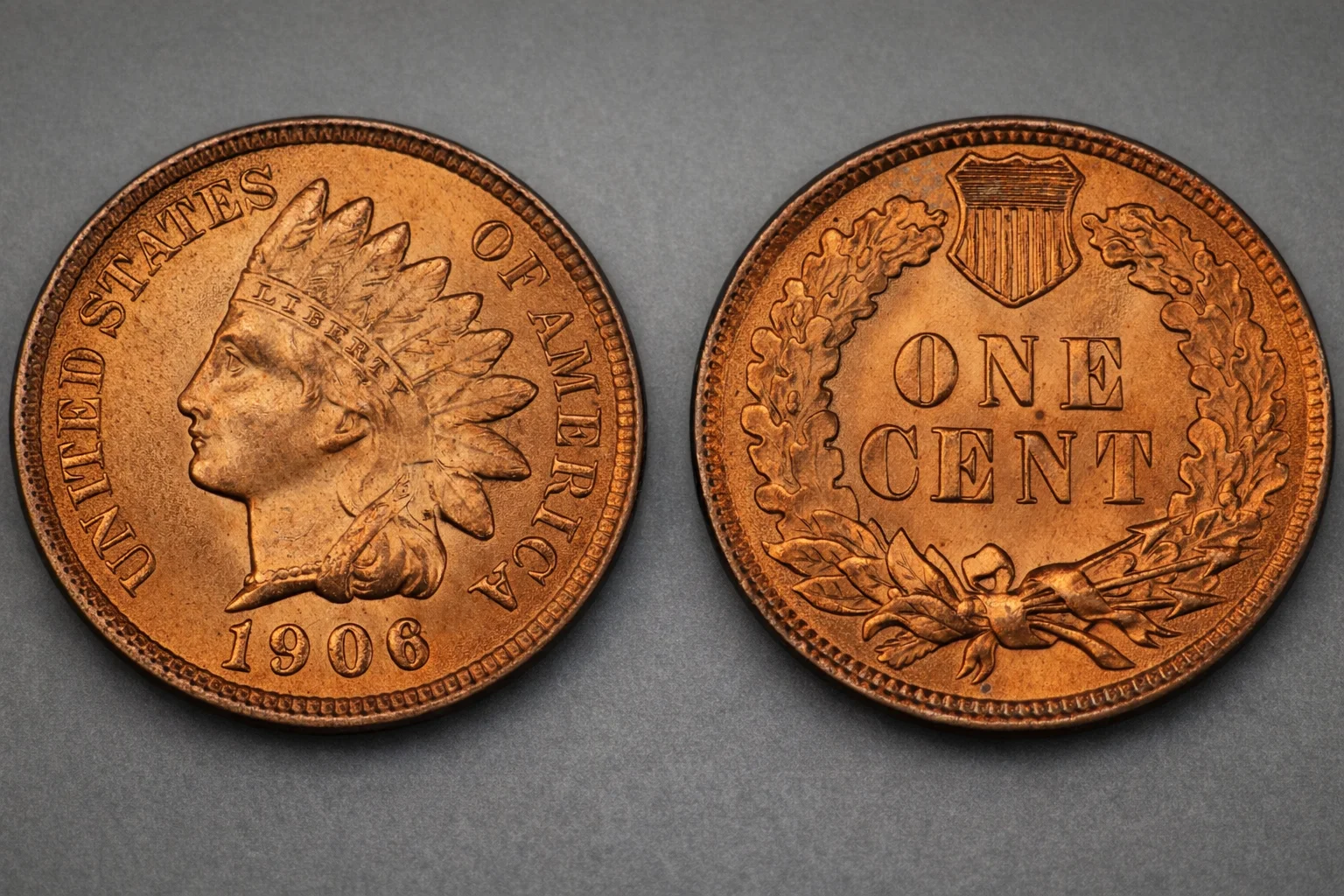
When collectors check the 1906 Indian Head penny value, most expect modest figures. The mintage reached 96,022,255 pieces. In worn condition, the coin is accessible. Even in mid-Mint State, prices remain reasonable.
Yet one certified example sold for $27,600 at Heritage Auctions. How does a common-date bronze cent cross into five-figure territory? Let’s check it out.
Production Reality: Why 1906 Was Not Supposed to Be Rare
The 1906 cent was struck only at Philadelphia. It carries no mint mark. It belongs to the final stretch of the Indian Head series, which ended in 1909.
Key specifications:
Parameter | Detail |
Year | 1906 |
Mint | Philadelphia |
Mintage | 96,022,255 |
Composition | 95% copper, 5% tin & zinc |
Weight | 3.11 grams |
Diameter | 19.05 mm |
Edge | Plain |
For basic verification of metal content, weight, and design type before deeper analysis, many collectors use tools such as Coin ID Scanner to confirm specifications and avoid confusion with cleaned or altered pieces.
As for parameters, nothing about these numbers suggests rarity. Production was high. The alloy was standard bronze. No design change occurred.
By mintage alone, this is not a key date.
That fact makes the five-figure result more interesting.
Condition Rarity: The True Driver of Price
Large output does not guarantee survival in top grade.
Most 1906 cents circulated heavily. Many were stored in paper rolls or albums that exposed them to sulfur and moisture. Bronze reacts quickly. Surfaces darken. Red turns to brown.
As a result, high-grade survivors with original color are limited.
Condition rarity means the year is common, but the finest preserved examples are scarce.
This concept explains why MS63 coins remain affordable while MS67 pieces move into another price tier.
The date is common. The preservation is not.
Color as a Multiplier
Copper-based coins are classified by color:
BN (Brown)
RB (Red-Brown)
RD (Red)
Freshly struck bronze appears bright red. Over time, oxidation changes the tone. Brown becomes the dominant surface color.
A fully red 1906 cent is difficult to preserve over more than a century.
The market recognizes this. In high grade, red examples command significant premiums over brown coins.
The difference is not small. It is structural.
An MS65 BN coin may sell in the four-figure range under certain conditions. An MS67 RD example can reach five figures.
Color does not change the metal. It reflects survival.
Auction Proof: Real Numbers
Verified sales show how preservation transforms price.
$1,200 for MS65+BN at Stack's Bowers
$690 for MS67 BN+RD at Heritage Auctions
$27,600 for MS67 RD at Heritage Auctions
These three results reveal the pattern.
The MS65+BN example already reached four figures. That shows strong demand even for brown coins in upper Mint State.
The MS67 BN+RD result appears lower, which reflects the influence of color balance and buyer perception.
The MS67 RD sale at $27,600 represents the peak of the market. Full red surfaces at that grade are rare. Registry collectors compete aggressively for them.
The difference between $690 and $27,600 is not the date. It is the surface.
Strike Quality: The Silent Factor
Color alone does not guarantee a top result.
Strike sharpness plays a critical role.
On the 1906 Indian Head cent, collectors examine:
Feather detail in Liberty’s headdress
Diamond clarity in the ribbon
Definition of lettering
Reverse wreath separation
Weakly struck coins may still grade high, but strong detail adds appeal.
An MS67 RD coin with crisp feather lines commands more attention than a softly struck example.
At five-figure levels, strike quality matters.
Surface Preservation and Eye Appeal
Bronze coins show every mark.
Small contact hits reduce grade quickly. Carbon spots interrupt visual balance. Cleaning leaves hairlines and dull fields.
Original luster should rotate smoothly under light. The cartwheel effect must remain uninterrupted.
Eye appeal influences bidding. Two coins with the same grade can produce different auction results if one has richer color or cleaner surfaces.
The market rewards originality.
Population Pressure
Population reports reveal the rarity curve.
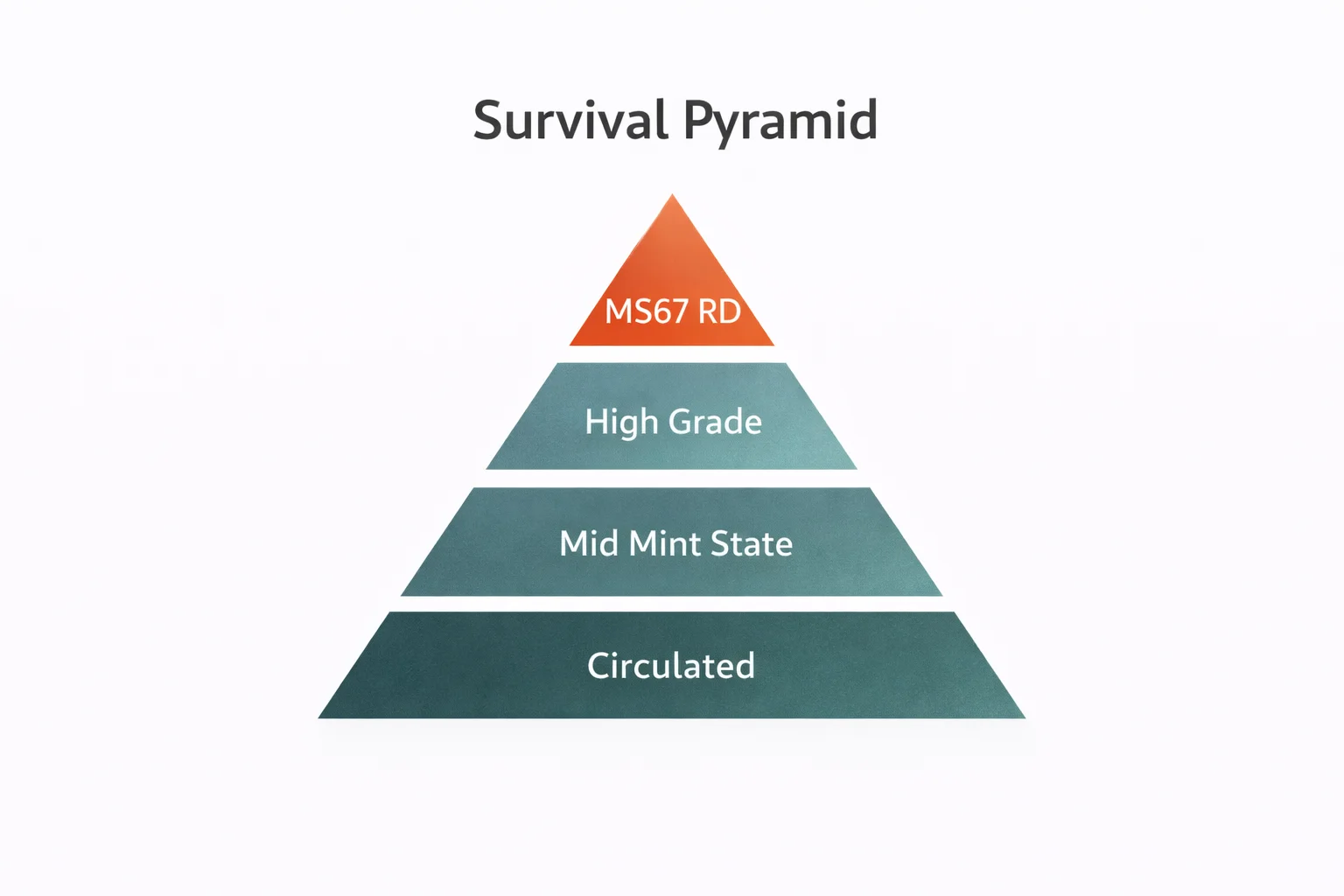
MS63 examples are plentiful. MS65 coins are available with effort. MS66 becomes more selective.
MS67 RD sits at the top of the survival pyramid.
When population counts remain low, registry competition drives prices upward. Buyers seeking the finest certified piece push bidding beyond typical retail levels.
Five-figure prices reflect this pressure.
Why Most 1906 Cents Stay Modest
The majority of surviving 1906 cents fall into circulated or mid-Mint State categories.
Common issues include:
Brown toning
Minor spots
Light friction
Surface dullness
Many coins were cleaned in the past, reducing long-term value.
Even attractive MS64 or MS65 pieces do not reach extreme price levels without rare color and preservation.
Most coins will never approach five figures. The ceiling belongs to exceptional examples.
Can Errors Reach That Level?
Extreme mint errors, such as off-metal strikes, can produce very high values. These are separate from standard business strikes.
However, for typical bronze issues, the most consistent path to a five-figure result remains:
MS67 RD certification with strong eye appeal.
Errors are rare. Elite condition is the more repeatable driver.
Practical Evaluation Checklist
Before assuming exceptional value, examine:
Weight at 3.11 grams
Consistent red color across fields and devices
No evidence of cleaning
Strong feather detail
Clean surfaces under magnification
Certified grade from a major service
Original surfaces matter more than brightness. Artificial red surfaces often fail under professional review.
High-grade coins should be handled carefully and stored in inert holders.
Final Assessment
The 1906 Indian Head cent is common by production totals. It circulated widely. Most examples remain affordable.
Yet a tiny fraction survived in exceptional condition with original red color and strong strike.
Those few pieces form a different market tier.
The five-figure result at $27,600 demonstrates what happens when preservation, color, and demand align. The year did not change. The metal did not change. The difference lies in the condition.
In the end, a common date can become extraordinary when survival reaches the highest standard.
Popular